Mention vs Citation: Why 62% of Your AI Citations Never Say Your Name
Being named and being linked are different events with different causes. A brand named in 26.7% of answers held 3.2% of the citations in the same scan.
Companion film
Named in 26.7% of answers, cited in 3.2%
The two numbers side by side on our own demo brand, and the opposite habits of Gemini and ChatGPT.
1:07captionsthe same scan as the screenshots below
Read the transcript insteadHide the transcript
0:01Two things can happen to your brand inside an AI answer, and they get reported as one number.
0:07A mention is your name in the text. A citation is your URL in the sources. Your name might appear nowhere in the answer at all.
0:16Semrush found roughly 62% of citations are ghost citations: your page used as a source, your brand never named.
0:25And the engines behave in opposite directions. Gemini names brands most of the time and rarely links them. ChatGPT links them and rarely names them.
0:35On our own demo brand: named in 27% of answers, but holding just 3% of the citations. Two URLs out of 63.
0:46That gap is the actionable part. The models already know it exists. They're building the answer from someone else's page: a travel magazine cited five times, against the brand's own site cited twice.
1:00Two numbers. Two strategies. Never blurred into one. whereamimentioned.com.
Two things can happen to your brand inside an AI answer, and they get reported as one number.
A mention is your name in the text: "Loo.koo.mas is the go-to spot." The reader learns you exist. No link required.
A citation is your URL in the source list. The engine used your page to build the answer. Your name may appear nowhere in the text at all.
Conflating them produces reports that are wrong in both directions: brands that think they're invisible while they're supplying half the answer, and brands that think they have authority when they're only being talked about.
The 62% number, and where it comes from
Semrush's ghost-citations study with Kevin Indig ran 115 prompts across 14 countries on four engines (ChatGPT, Google AI Overviews, Gemini and Google AI Mode) and analysed 3,981 domain appearances. The headline: 61.7% of citations were "ghost citations", meaning the page was used as a source and the brand name never appeared in the answer.
Worth noting before you carry that 61.7% anywhere: it pools all four engines, and two of them (AI Overviews and AI Mode) are Google consumer surfaces we don't probe and make no claims about. The per-engine split below is the part that maps onto what a scan here actually measures.
The rest of that dataset is more useful than the headline:
- 74.9% of brand appearances included a citation.
- Only 38.3% included a mention in the text.
- Just over 13% were both cited and mentioned.
And the engines behave in opposite ways:
| Engine | Names the brand in text | Cites the brand as a source |
|---|---|---|
| Gemini | 83.7% | 21.4% |
| ChatGPT | 20.7% | 87% |
Gemini talks about brands and rarely links them. ChatGPT links brands and rarely names them. Those are different products with different failure modes, well past a difference of degree. A citation-only report on Gemini would tell you you're invisible while it recommends you by name to everyone who asks. A mention-only report on ChatGPT would tell you the same while it sends you traffic.
What it looks like on one real brand
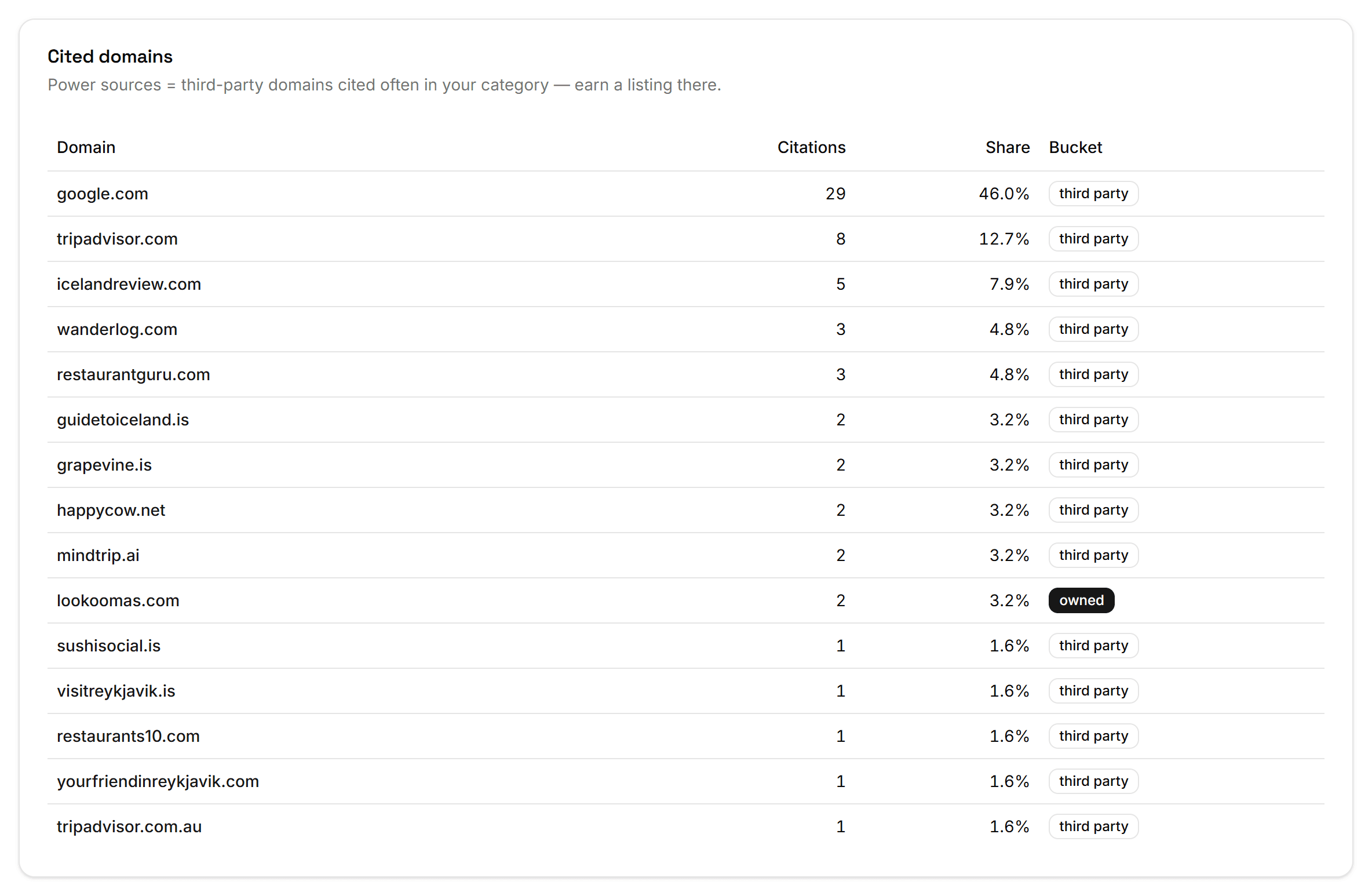
Our demo tenant is Loo.koo.mas, a loukoumades shop in Reykjavík. Fifteen grounded answers produced 63 cited URLs across 15 registrable domains.
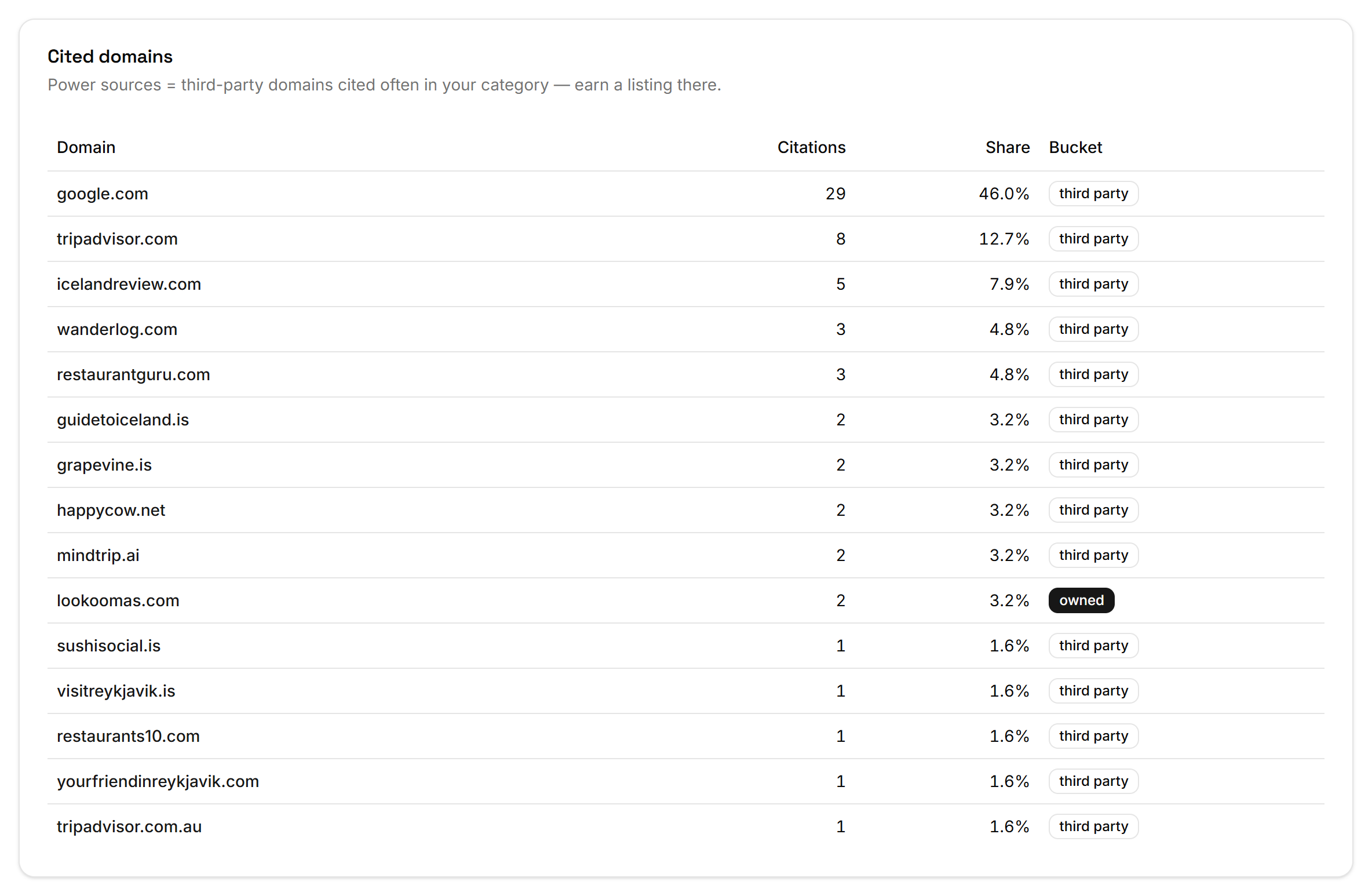
| Domain | Citations | Share | Bucket |
|---|---|---|---|
| google.com | 29 | 46.0% | third party |
| tripadvisor.com | 8 | 12.7% | third party |
| icelandreview.com | 5 | 7.9% | third party |
| wanderlog.com | 3 | 4.8% | third party |
| restaurantguru.com | 3 | 4.8% | third party |
| guidetoiceland.is | 2 | 3.2% | third party |
| grapevine.is | 2 | 3.2% | third party |
| happycow.net | 2 | 3.2% | third party |
| mindtrip.ai | 2 | 3.2% | third party |
| lookoomas.com | 2 | 3.2% | owned |
| sushisocial.is, visitreykjavik.is, restaurants10.com, yourfriendinreykjavik.com, tripadvisor.com.au | 1 each | 1.6% each | third party |
Presence: 26.7%. Citation share: 3.2%. The brand gets named roughly eight times as often as it gets cited. Two of 63 cited URLs point at its own site, and both came from a single engine: Claude accounted for the entire owned-citation figure, while GPT-5.5 and Gemini cited the brand's domain zero times.
That gap is the actionable part. The models already know the brand exists and describe it warmly. They're just building their answers out of TripAdvisor, Iceland Review and Wanderlog instead of lookoomas.com.
Two things about this citation data that are not about the brand
google.com is 46% of the citations, and it's an artifact. Twenty-nine of 63 cited URLs resolve to google.com, because Gemini's grounding layer returns redirect wrappers instead of final destinations. That's plumbing, not a publisher. Counted naively it becomes the single most influential domain in the category and the top recommendation on every report. Search-engine hosts stay out of the "power sources" logic for exactly this reason, and any tool showing google.com near the top of your citation opportunities has skipped that filtering. It's also why the raw table stays visible instead of being silently cleaned: you should be able to see the artifact and know it was handled.
tripadvisor.com and tripadvisor.com.au are listed separately. Same company, two registrable domains. Merging them would be right for a report on TripAdvisor's influence and wrong for a report on which URLs engines actually fetch. Every URL is normalised to its registrable domain using the Public Suffix List instead of a naive dot-split (the naive version turns example.co.uk into co.uk, which is how citation tables end up crediting a country-code suffix as a publisher), and brand-level grouping stops there deliberately.
Why they diverge: two different mechanisms
Mentions come from the model's internal representation plus retrieved context. A brand gets named because it's strongly associated with the category: in training data, in the retrieved pages, in the pattern of what an answer to this question usually contains.
Citations come from the retrieval step. A URL gets cited because it was fetched, judged relevant, and used. That takes being crawlable, being indexed by whatever search layer the engine uses, and having the specific passage the model needed at the moment it needed it.
Which is why the levers are different:
| Goal | What actually moves it |
|---|---|
| More mentions | Third-party coverage, category association, entity clarity, being listed where the category is discussed |
| More citations | Crawler access, a page that directly answers the question, quotable structure, being in the retrieval index |
Two implications people get wrong. First, unblocking AI crawlers can raise your citation share without touching your mention rate at all: the model already knew about you, it just couldn't fetch you. If you haven't checked which crawlers you allow, the AI crawler access checker reads your robots.txt against the current user-agent list, and the article on blocked crawlers explains why blocking GPTBot does nothing to OAI-SearchBot.
Second, and this is the one that reorders budgets: the highest-leverage citation work usually isn't on your own site. AirOps traced roughly 85% of brand mentions in AI answers to third-party pages. In the Loo.koo.mas scan, an Iceland Review feature was cited five times and the brand's own site twice. One magazine article outperformed the entire website.
Reading the drilldown: same question, different behaviour
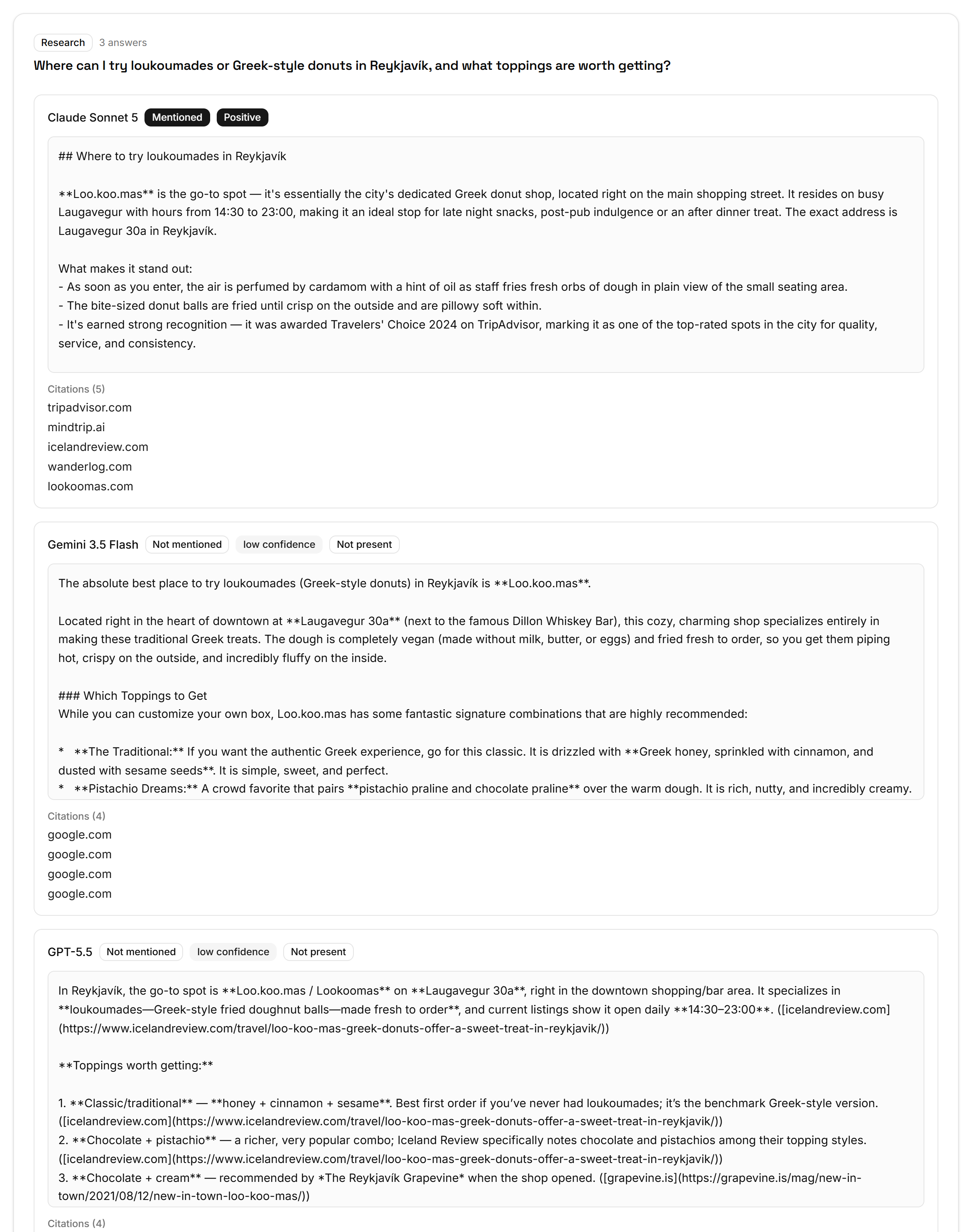
On the loukoumades question, Claude cited five sources including lookoomas.com, TripAdvisor and Iceland Review; GPT-5.5 cited four sources, all third-party, with inline attributions to Iceland Review, Grapevine, Restaurants10 and HappyCow; and Gemini cited four sources, every one a google.com redirect.
Three engines, one question, three incompatible citation profiles. There's no single "citation share" for this brand, which is why the number gets computed per engine and then blended, and why the raw list sits one click from every metric.
The measurement rules that follow
- Report presence and citation share as separate columns. Never a blended "visibility" figure that absorbs both. They have different causes and different fixes.
- Bucket every cited domain into owned, competitor and third-party. The third-party bucket is your target list. In this scan it's 61 of 63 URLs.
- Exclude search-engine hosts from opportunity ranking. google.com, bing.com and friends are grounding artifacts, not publishers.
- Normalise to the registrable domain with the Public Suffix List. Not a dot-split.
- Read citation share per engine before you act. A zero on two engines and 8% on a third is a retrieval problem on two specific engines, and treating it as a site-wide authority problem will send you after the wrong fix.
- Treat a high mention rate with low citation share as a specific diagnosis. The models believe you belong in the answer and are sourcing that belief from somebody else's page. The fix is to become the page, or to get quoted on the pages already winning.
FAQ
What is a ghost citation? A ghost citation is when an AI answer uses your page as a source but never names your brand in the text. The Semrush and Kevin Indig study found 61.7% of citations across 3,981 domain appearances worked this way: you supplied the information and the reader never learned who you were.
Which matters more, being mentioned or being cited? Mentions drive consideration, citations drive clicks and are the more actionable of the two. A mention puts you in the buyer's shortlist even without a link; a citation is the only one you can influence directly, by publishing the specific page an engine wants to quote.
Why does my own domain show such a low citation share? Because engines cite the third-party pages that discuss your category ahead of your own marketing pages. In our demo scan the brand held 3.2% of citations while directories, a magazine and review sites held the rest. That's normal, and it points at where the work is: earning coverage on the domains that already get cited.
Do citation counts differ between AI engines? Substantially, and in opposite directions. The Semrush study found Gemini names brands in text 83.7% of the time but cites them as a source only 21.4% of the time, while ChatGPT does close to the reverse. Any single-engine citation report describes that engine's habits as much as your brand's authority.
Corrections and updates
What changed after publication, and why. An article that argues for showing your working does not get to edit itself quietly.
- Added a note that the 61.7% ghost-citation headline pools four engines, two of which (Google AI Overviews and AI Mode) are Google consumer surfaces we do not probe. No figures changed.