Share of Voice in AI Answers: 19% or 40%? The Denominator Decides
One scan, two legitimate Share of Voice figures, 19.0% and 40.0%, separated only by which brands you count. Why we publish the smaller one.
Companion film
The same scan reading 19% and 40%
One scan, two denominators, and the ten brands a closed competitor list would never have contained.
1:08captionsthe same scan as the screenshots below
Read the transcript insteadHide the transcript
0:01Share of voice is the most quietly manipulable number in AI visibility reporting. Not the numerator, the denominator.
0:10One scan. Fifteen answers. Count every brand the models actually named, and this shop holds 19%.
0:18Count only the five rivals it declared at signup, and the same scan reads 40%. Neither figure is a lie. Only one of them is useful.
0:27Because 10 of the 15 brands were never on that list. A coffee house took second place among rivals. The one other Greek food business showed up on the exact question that matters most.
0:39A closed list encodes who you think you compete with. The answers tell you who the models think you compete with, and that's the only competitive set your buyers will ever see.
0:50It costs you something, and we'll say so: two restaurants got counted that aren't really competitors. Read the table, not just the headline.
0:59Before you compare share of voice between two tools, ask what's in the denominator. whereamimentioned.com.
Share of Voice is the most quietly manipulable number in AI-visibility reporting. Nobody fakes the numerator, because mentions are mentions. The denominator is where it happens: it's a choice, almost nobody discloses it, and it can double your score.
Here's the same scan computed both ways.
One scan, two honest answers
Five buyer questions, three grounded models, 15 answers, about a loukoumades shop in Reykjavík called Loo.koo.mas. Four confirmed mentions of the brand. Across the whole answer set, models named fifteen brands in total, producing 21 brand mentions.
Open denominator (every brand the models actually named):
SoV = 4 / 21 = 19.0%
Closed denominator (the brand plus the five competitors declared during onboarding: Valdís, Gaeta Gelato, Omnom, Ísbúðin litla Valdís, Brauð & Co), which collectively took 6 mentions:
SoV = 4 / (4 + 6) = 40.0%
Nineteen percent, or forty percent. Same answers, same detection, same day. Neither figure is a lie. Only one of them is useful.
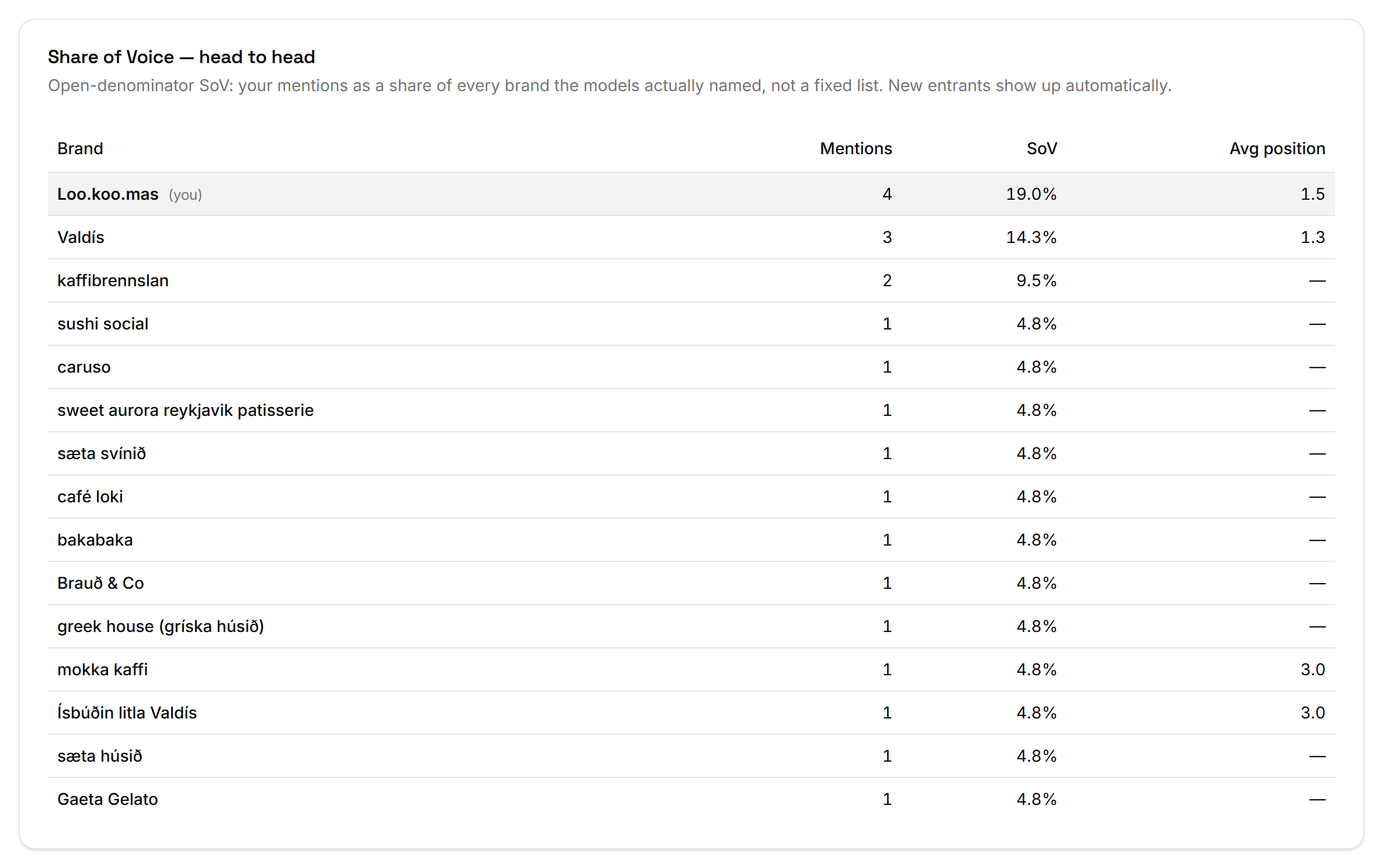
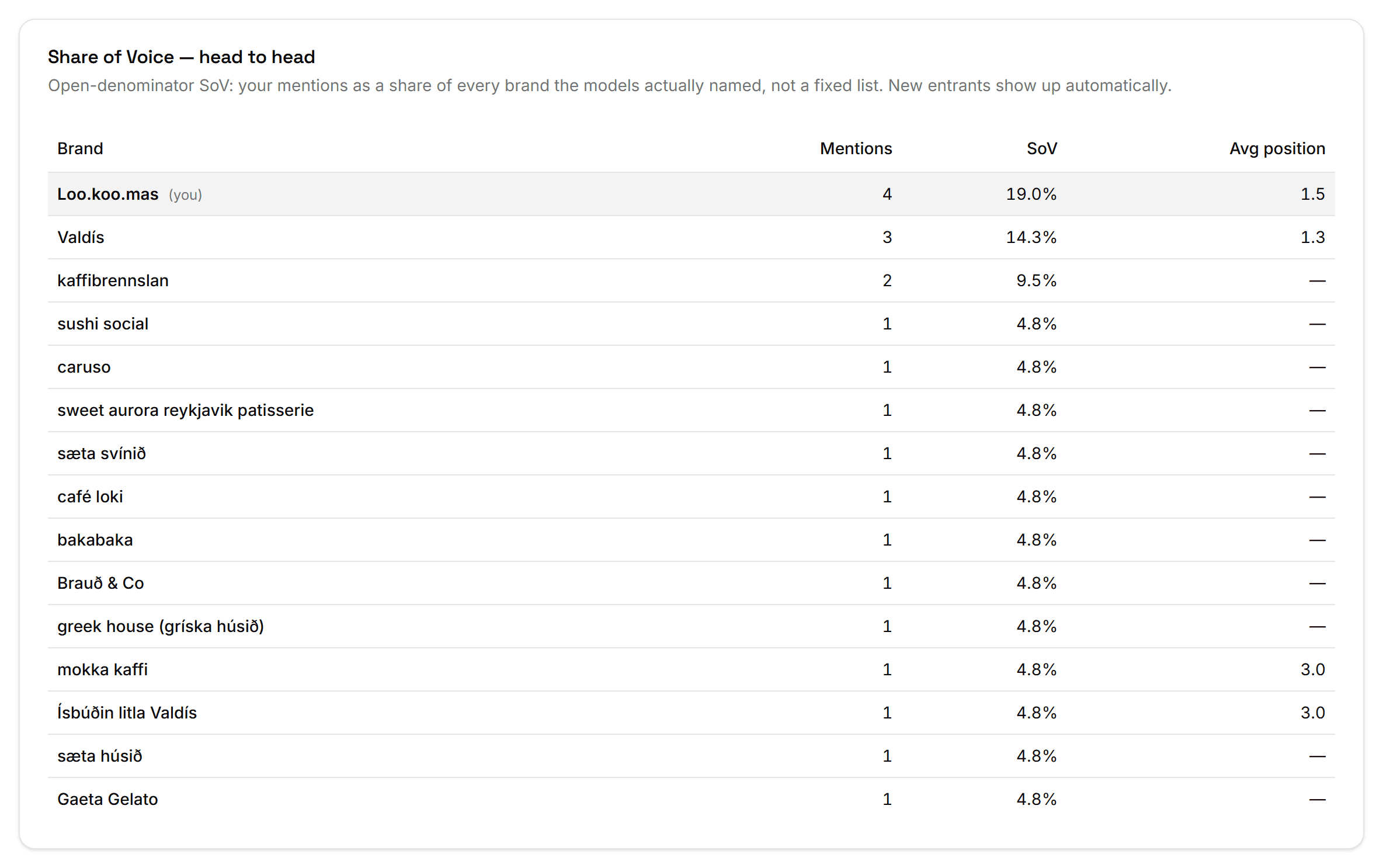
Where the 21 points of difference went
The gap is made of brands nobody put on a list:
| Brand | Mentions | Open SoV | On the competitor list? |
|---|---|---|---|
| Loo.koo.mas | 4 | 19.0% | (target) |
| Valdís | 3 | 14.3% | Yes |
| kaffibrennslan | 2 | 9.5% | No |
| Ísbúðin litla Valdís | 1 | 4.8% | Yes |
| Gaeta Gelato | 1 | 4.8% | Yes |
| Brauð & Co | 1 | 4.8% | Yes |
| sæta húsið | 1 | 4.8% | No |
| sæta svínið | 1 | 4.8% | No |
| café loki | 1 | 4.8% | No |
| mokka kaffi | 1 | 4.8% | No |
| sushi social | 1 | 4.8% | No |
| caruso | 1 | 4.8% | No |
| bakabaka | 1 | 4.8% | No |
| greek house (gríska húsið) | 1 | 4.8% | No |
| sweet aurora reykjavík patisserie | 1 | 4.8% | No |
| Omnom | 0 | 0% | Yes (never mentioned) |
Ten of the fifteen brands were never declared as competitors. One declared competitor, Omnom (a well-known Icelandic chocolate maker), was never mentioned by any model. The competitor list was mostly wrong in both directions.
Two of the discoveries are genuinely useful. Kaffibrennslan took two mentions, second only to Valdís among rivals, and it's a coffee house, which tells you models treat "warm indulgent thing after dinner in Reykjavík" as a category spanning coffee shops as well as dessert shops. Greek house (gríska húsið) is the only other Greek-food business in the set and appeared on the loukoumades question specifically: a direct category rival that a dessert-shop-shaped competitor list would never have contained.
That's the case for the open denominator in one paragraph. A hand-picked list encodes who you think you compete with. The answers tell you who the models think you compete with, and that's the only competitive set your buyers will ever see.
The honest cost of the open denominator
An open denominator also lets in things that aren't competitors at all.
Sushi Social and Caruso are restaurants. They showed up because a model reached for "somewhere memorable to eat in central Reykjavík" and wandered out of the dessert category. Counting them drags Loo.koo.mas's share down for no competitive reason.
That's a real cost and it deserves saying plainly. The mitigation is structural rather than clever: with an open denominator, the shape of the table does the filtering. Two brands have repeated mentions. Twelve have exactly one, a flat tail at 4.8% each, which is what a single mention looks like at this sample size and is indistinguishable from noise. Read the table and the real competitive set is obvious: Loo.koo.mas, Valdís, and possibly Kaffibrennslan. Everything below that got said once.
Filtering the tail by hand would produce a tidier number and reintroduce exactly the bias the open denominator exists to remove, because the only tool available for deciding which one-mention brands are "real" competitors is the same intuition that left Greek House off the list to begin with.
Why closed denominators are the industry default
Because they flatter, and because they're stable.
A closed denominator against five rivals mathematically floors your share at 1/6 (16.7%) if you're mentioned at all, and rewards you for picking rivals who do badly. Add a sixth competitor who never gets mentioned and your share goes up. It's a number you can improve by editing a settings page.
It also produces smooth month-over-month charts, because the denominator sits still. An open denominator's charts are lumpier: a new entrant appearing in your category lowers your share even when your own presence is flat. That lumpiness is information, and it's the specific information a closed denominator is engineered to suppress. When a challenger starts appearing in AI answers about your category, you want to find out from your dashboard rather than from a sales call six months later.
The practical consequence for anyone comparing tools: a vendor reporting your Share of Voice at 40% and one reporting 19% may be looking at identical data. Before you compare, ask what's in the denominator. If the answer is vague, the number is comparable to nothing.
Share of Voice is not presence, and both are needed
They answer different questions and they move independently:
| Presence rate | Share of Voice | |
|---|---|---|
| Question | Do you appear? | How much of the attention did you take? |
| Denominator | Answers in the scan | Brand mentions in the scan |
| Loo.koo.mas | 26.7% (CI 10.9–52.0) | 19.0% |
| Moves when a rival gains? | No | Yes |
| Moves when a rival is added to your list? | No | Only with a closed denominator |
A brand can hold presence steady while Share of Voice falls. That's precisely what a competitor's successful campaign looks like from your side. A brand can also gain Share of Voice while presence is flat, if the models start naming fewer alternatives alongside you. Watch only one of these numbers and you'll misread at least one of those situations.
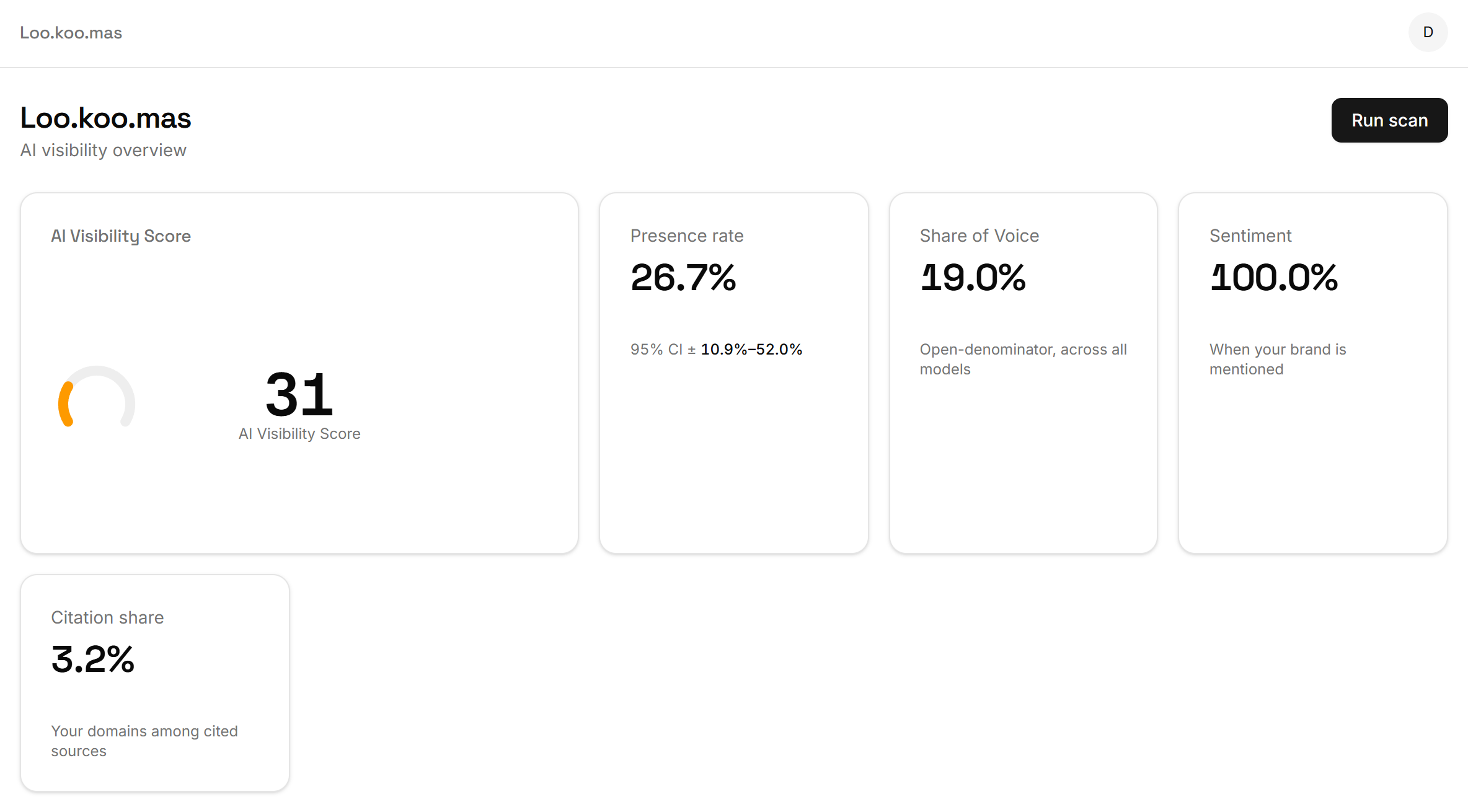
Both sit next to each other on the overview for that reason, and both drill down to the answers behind them. The composite score weights them at 0.30 and 0.20 respectively, presence higher because it's the necessary condition and the less noisy measurement, as the score breakdown sets out.
Position-weighted Share of Voice, and when to ignore it
There's a sharper variant. Instead of counting each mention as 1, weight it by placement with harmonic decay (first mention 1.0, second 0.5, third 0.33) so being named first counts for more than being named ninth.
Better metric in principle, trap in practice at low repetition counts. Ordering inside AI answers is close to random between runs; SparkToro's 2026 study found the same brands in the same order under 0.1% of the time. Weight by a near-random quantity and you amplify a coin flip. Position weighting only becomes meaningful once each prompt has been run enough times for average placement to stabilise (five runs is the floor), which is why it stays gated behind repetition count instead of being switched on to make numbers look more sophisticated.
Three checks before you report a Share of Voice figure
- Name the denominator out loud. "19% of all 21 brand mentions across 15 answers, open denominator" is a claim someone can check. "19% share of voice" isn't.
- Read the tail before you read the headline. If most brands in the table have exactly one mention, your denominator is dominated by single observations and the whole figure needs a bigger sample before it means anything.
- Look for the brands you didn't list. They're the actual output of this metric. In this scan they were a coffee house and a Greek restaurant: two competitors that were invisible on the competitor list and obvious in the answers.
FAQ
What is Share of Voice in AI answers? Your mentions as a fraction of all brand mentions across a set of AI answers. Unlike presence rate, which asks whether you appear, Share of Voice asks how much of the available attention you took, so it moves when competitors gain ground even if your own presence is unchanged.
What is the difference between an open and a closed denominator? A closed denominator counts only you plus a competitor list you supplied. An open denominator counts every brand the models actually named, discovered from the answers themselves. Closed denominators produce higher numbers and hide brands you didn't think to list; open denominators are lower and harder to game.
Why is my Share of Voice lower in one tool than another? Usually the denominator rather than your performance. A tool using your five declared rivals as the denominator can report double the figure of a tool counting every brand mentioned. Ask any vendor what sits in the denominator before comparing numbers between tools.
Does an open denominator add noise? Yes, and that's a real cost. Adjacent businesses that aren't true competitors get counted, which drags your share down. The mitigation is a long tail of one-mention brands that's visibly distinguishable from the two or three brands with repeated mentions. Read the table, not just the headline percentage.