What One AI Visibility Scan Actually Costs: $2.14 for 15 Answers
Real per-answer costs from a real scan: 26.5¢ on GPT-5.5, 5.4¢ on Gemini. The engine that cost five times more scored four times lower.
Companion film
$2.14 for 15 answers, and the priciest engine scored lowest
The invoice itemised per engine, and the square-root curve that decides what precision costs.
1:08captionsthe same scan as the screenshots below
Read the transcript insteadHide the transcript
0:01Almost nobody in this category publishes what a scan costs to run. So here's ours, itemized.
0:08Fifteen grounded answers. Two dollars and fourteen cents. About 14 cents an answer, on a premium three-model panel.
0:16But the spread is the story. GPT-5.5: 26.5 cents an answer. Claude: 11. Gemini: 5.5. A five-fold difference for the same questions.
0:29And the most expensive engine produced the lowest score of the three. What you pay per probe and what you learn per probe are unrelated.
0:38Cost is linear in answers. Precision is a square root. Halve your error bar and you quadruple the bill, which is the whole of AI visibility budgeting.
0:48That's why one credit is one answer. One prompt, one model, one run. It's the unit of cost, the unit of precision, and the unit of evidence you can click into.
0:59Or bring your own key and pay wholesale. Either way you see the cost of every probe. whereamimentioned.com.
Almost nobody in this category publishes what a scan costs to run. Here's ours, itemised, from a real completed scan against a real business: Loo.koo.mas, a loukoumades shop in Reykjavík.
Five prompts × three grounded models × one run = 15 answers. Total spend: $2.1367. About 14.2¢ per grounded answer.
Where the $2.14 went
| Engine | Answers | Total | Per answer | Avg latency |
|---|---|---|---|---|
| GPT-5.5 | 5 | $1.3235 | 26.47¢ | 107.0 s |
| Claude Sonnet 5 | 5 | $0.5451 | 10.90¢ | 20.7 s |
| Gemini 3.5 Flash | 5 | $0.2681 | 5.36¢ | 9.2 s |
| Total | 15 | $2.1367 | 14.24¢ | n/a |
A 4.9× cost spread and an 11.7× latency spread across three engines answering identical questions. GPT-5.5 alone consumed 62% of the budget for 33% of the answers.
Then the part that should reorder your panel:
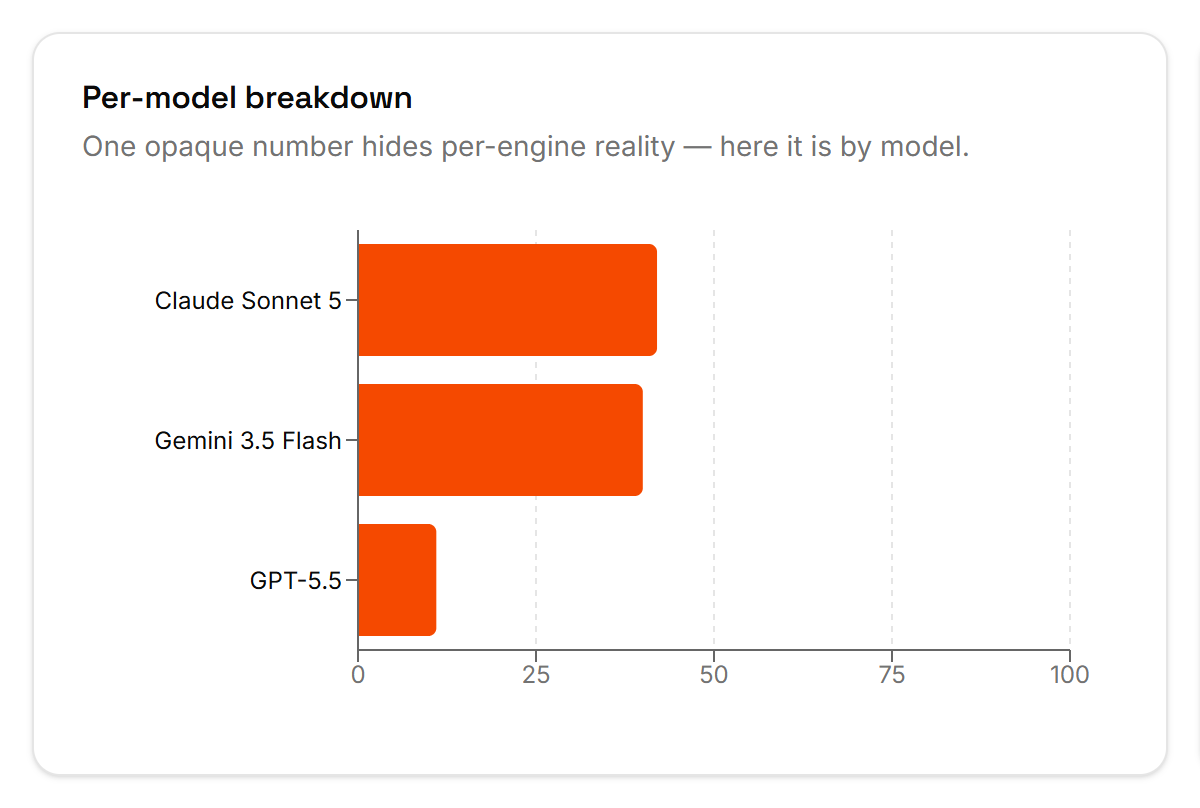
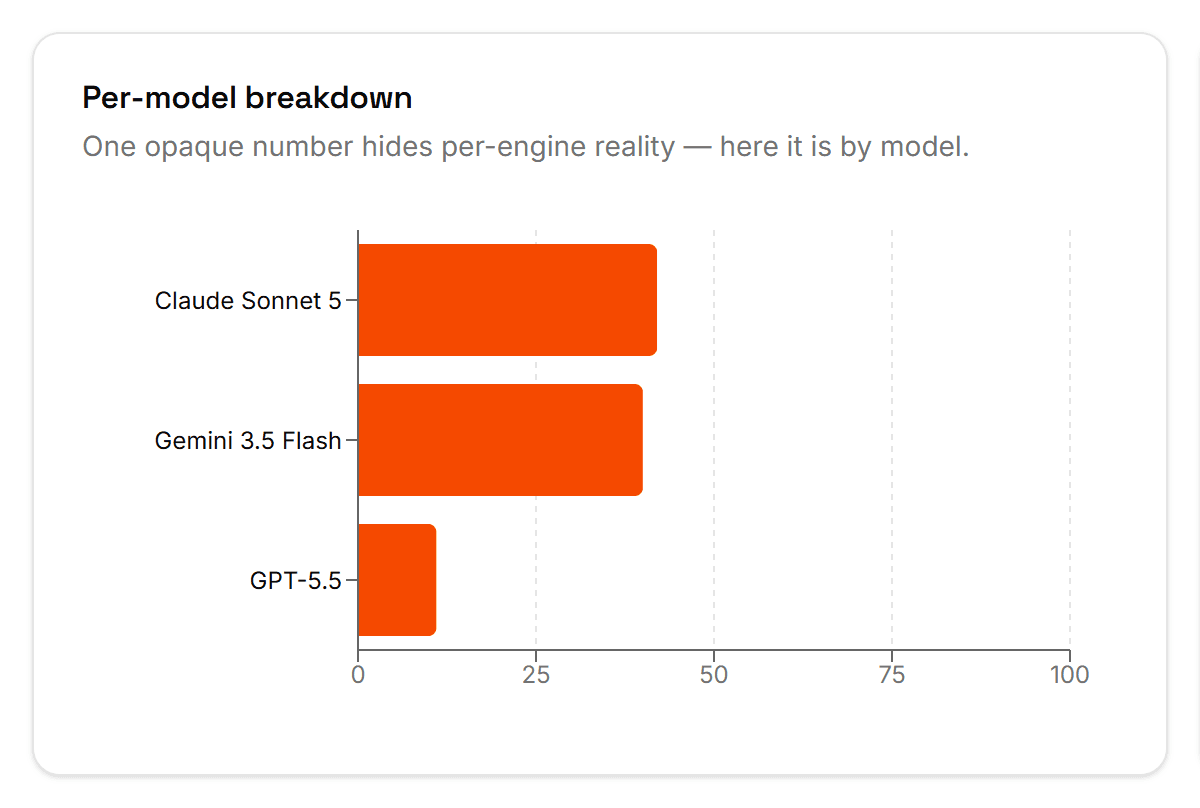
GPT-5.5, the most expensive engine by a wide margin, produced the lowest score of the three: 11, against Gemini's 40 and Claude's 42.46. Cost per probe and informativeness per probe are unrelated quantities. The engine you pay the most for isn't the engine telling you the most; it's the engine whose answer surface matters most commercially, which is a different reason to keep it.
What makes a grounded probe cost what it does
Three components, and only one of them is the model's list price:
Search. Every grounded probe makes at least one live web-search call. On the order of half a cent, roughly fixed per probe, invisible in token pricing.
Tokens, dominated by output length. Grounded answers are long (several of ours ran 2,000 to 2,900 characters), and output tokens cost several times what input tokens cost. That's why the same prompt costs five times more on one engine than another, and why capping max_tokens is a cost control as well as a variance control.
The extraction pass. Each stored answer gets a second, cheap call that turns prose into structured signals: was the brand named, in what position, alongside which other brands, with what sentiment, citing which sources. On a small model this runs a tenth to a fifth of a cent, a rounding error next to a premium probe, which is why mention detection isn't what makes scans expensive.
Latency deserves its own note because it shapes the product. At 107 seconds per grounded answer on GPT-5.5, a 540-answer scan is well past what a web request can wait for. Scans run as durable background jobs with per-model concurrency queues and retry-after handling on rate limits: an architectural consequence of the cost model rather than a feature choice.
Scaling the bill
Cost is linear in answers. Precision follows a square root, so halving your error bar quadruples your bill. That arithmetic is the whole of AI-visibility budgeting.
At the premium panel rate of ~14¢ per answer:
| Configuration | Answers | Approx. spend | Worst-case ± |
|---|---|---|---|
| 5 × 3 × 1 | 15 | $2.14 | ±25.3 pts |
| 25 × 4 × 1 | 100 | ~$14 | ±9.8 pts |
| 30 × 4 × 3 | 360 | ~$51 | ±5.2 pts |
| 30 × 6 × 3 | 540 | ~$77 | ±4.2 pts |
| 100 × 6 × 3 | 1,800 | ~$256 | ±2.3 pts |
Weekly at 540 answers is roughly $4,000 a year in model spend alone. That's a real number to put next to the question of whether you need weekly cadence, especially since cited-domain turnover runs 40–60% monthly. The drift you're chasing moves on a slower clock than that.
Panel composition is the biggest lever available. Substituting cheaper grounded models for premium ones drops the per-answer figure severalfold, and open-weight models grounded through a search tool land closer to a cent than fifteen. The trade is coverage of the surfaces your buyers actually use: a cheap panel measures a cheap panel.
Why credits are denominated in answers
One credit is one answer: one prompt, one model, one run. Not one dollar, not one scan, not one prompt.
I chose that deliberately. The answer is simultaneously the unit of cost, the unit of statistical precision, and the unit of evidence you can click into. A scan of 25 prompts across 4 models at 1 run costs 100 credits, gives you 100 observations, and produces 100 readable answers. There's no conversion to do in your head, and no way for a "scan" to quietly mean something different this month than last.
Denominating in scans is where opacity enters. A "scan" whose prompt count, engine count and repetition count are all the vendor's discretion is a unit that can shrink without notice.
| Plan | Price | Monthly credits | Prompts / workspace | Max runs | BYOK |
|---|---|---|---|---|---|
| Single Brand | €10 | 48 | 15 | 1 | No |
| Pro | €119 | 500 | 150 | 3 | Yes |
| Agency | €419 | 2,500 | 200 | 10 | Yes |
Read those credit numbers against the precision table above and the plans stop being a feature grid and become a statement about what each one can measure. Forty-eight credits is two scans of six prompts across four models: enough to read raw answers and find out whether you appear at all, which is genuinely the right first question. It won't get you to a reportable rate, and the interval on the overview will say so.
Pro's 500 credits with up to three runs is the first tier where repetition becomes possible, and repetition is the only way to measure volatility instead of merely suffering it. Agency's ten runs is where position-weighted metrics become trustworthy, since ordering needs five or more repetitions before averaged placement means anything.
Credit packs (1,000 / 5,000 / 20,000) exist for the bursty reality of agency work, where a new client audit won't respect a monthly allotment.
Bring your own key, and why the cost stays visible either way
On Pro and Agency you can point the platform at your own provider key. Scans then run on your account at your cost with no credit consumption.
The part worth noting is what stays the same: per-probe cost is still recorded and still shown. There's no version of this product where the cost of a scan is hidden from you, whoever paid for it. A tool that hides its own cost of goods can quietly degrade the panel (swap a premium engine for a cheap one, drop a repetition) and report the same confident number to you afterwards. Metering on the provider's reported cost per generation, and showing it, is what makes that change detectable.
Spend caps are enforced provider-side per workspace instead of in application code, so a runaway scan hits a hard ceiling at the source rather than relying on our own bookkeeping to stop it.
Spending nothing first
Before any of this arithmetic matters, the free checker runs two questions across three grounded models with no login. Six answers, on us.
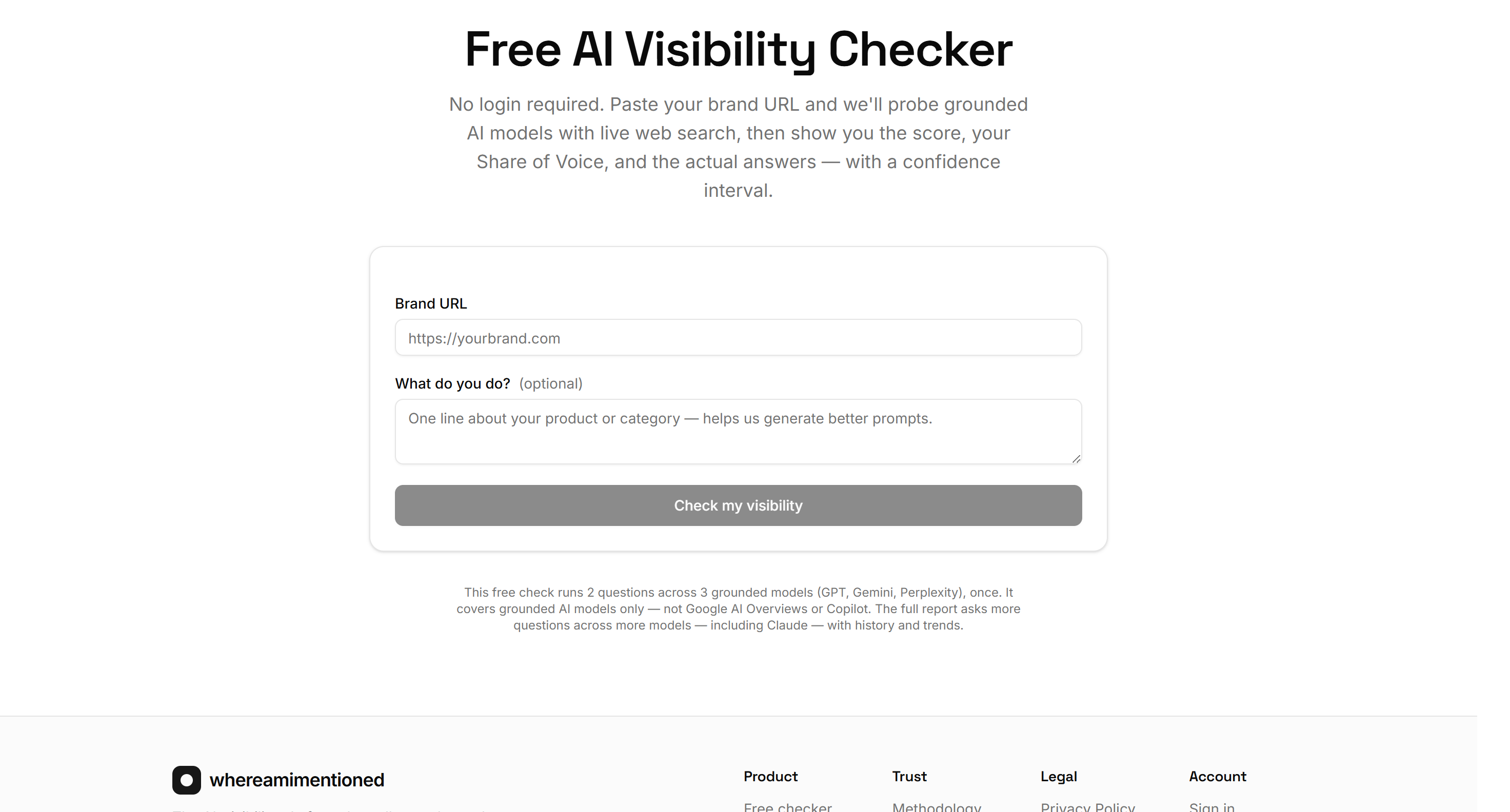
Six answers won't give you a rate: the interval will be embarrassingly wide, and it's shown anyway. What six answers will tell you, reliably, is whether the models know you exist and what they say when they do. That's the finding worth having before you spend anything, and it's the one that decides whether the rest of the budget makes sense.
The fourteen free tools are all rule-based rather than model-backed, so they carry no probe cost at all, which is how they stay free without a usage cap quietly appearing later.
The sizing decision, priced
- Start at six answers, free. Read them. Roughly half the time this ends the project: the models either clearly know you or clearly don't.
- Buy 100 answers (~$14) for a directional read. 25 prompts across 4 engines, one run. Enough for a ±10-point interval and a per-engine split.
- Cost your target precision before committing to a cadence.
n = (0.98 / target)², times your per-answer rate, times scans per year. Do that multiplication before you promise anyone a monthly report. - Trim the panel, not the prompt set. Dropping the most expensive engine cuts more cost than dropping five prompts, and prompts are the only axis that buys new information as well as precision.
- Move to your own key when monthly answer volume goes four figures. That's roughly where per-answer cost at wholesale beats bundled credits.
- Freeze the prompt set once you're paying for trends. Changing prompts between scans invalidates the comparison you're buying, and no amount of credits repairs that.
FAQ
What is a credit in AI visibility tools? In whereamimentioned, one credit is one answer: a single prompt, on a single model, for a single run. A scan of 25 prompts across 4 models at 1 run costs 100 credits. Denominating credits in answers rather than in dollars or scans keeps the unit the same as the unit of statistical precision.
Why do some AI models cost five times more per probe than others? Token pricing differs by an order of magnitude across families, and grounded answers are long. In our real scan, GPT-5.5 averaged 26.5¢ per grounded answer against Gemini 3.5 Flash at 5.4¢. Search calls add a small fixed cost on top of tokens.
Is bring-your-own-key cheaper than buying credits? It moves the model spend onto your own provider account at cost, with no credit consumption, which suits high-volume users. You still see the cost of every probe. It's available on Pro and Agency plans.
How long does a grounded AI visibility scan take? Minutes, not seconds, and the slowest engine sets the pace. In our scan GPT-5.5 averaged 107 seconds per grounded answer against Gemini's 9 seconds. Scans run as durable background jobs for that reason.